This is far from my usual topics of Django, Postgres and AWS bills. But I've spent most of my career thinking about what happens when automation stops and people take over. On Wednesday that question cost lives in Spain.
At least 69 people were killed when two high-speed trains collided near Urda, in Toledo province, on the morning of Wednesday 28 October. My thoughts are with them, their families and everyone still in hospital.
What follows is based only on what officials, the accident investigators and reliable outlets had reported as of the evening of Friday 30 October in Spain (the morning of Saturday 31 October in Sydney). The investigation has barely started. The investigators' first note is a description, not a finding, and nobody should be judged on a blog post.
What we know so far
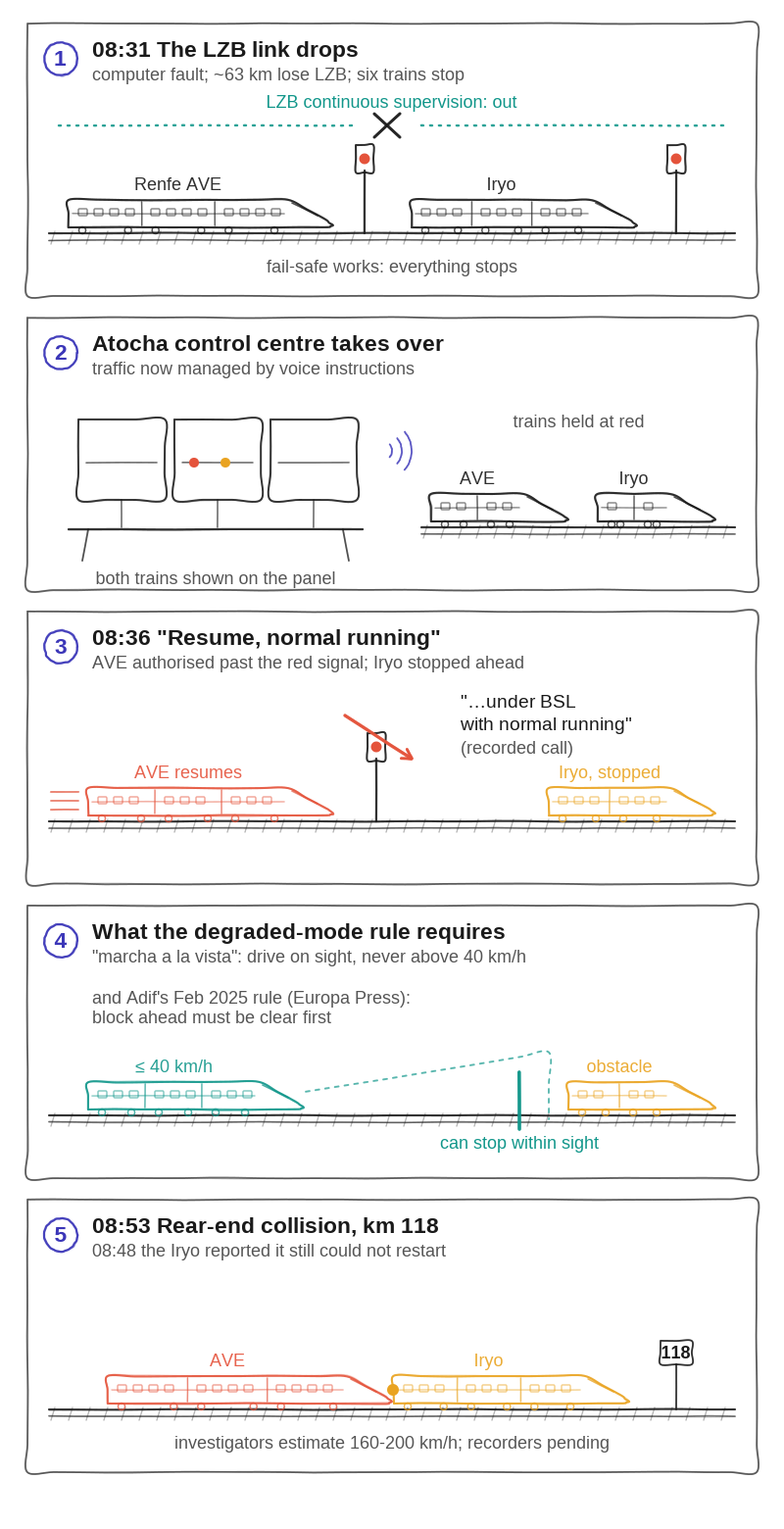
- The collision. At about 08:53, a Renfe AVE travelling south from Madrid ran into the back of an Iryo train that was stopped on the line. It happened at kilometre 118 of the Madrid–Seville high-speed line, just short of Urda station (El País, Reuters).
- The toll. The provisional count is 69 dead, and officials have not ruled out more: by Friday there were 70 missing-person reports, and the regional president said up to 31 bags of partial remains had still to be analysed. Forensic teams had carried out 65 autopsies and 13 victims had been identified (EFE, Euronews). Earlier in the count, when it stood at 68, the regional president said 44 of the dead had been on the Iryo and 24 on the AVE (CLM Press); I haven't seen a breakdown of the latest figure. Of the 110 injured people admitted to the region's hospitals, 71 had gone home by Friday and 39 were still in hospital, 17 of them in intensive care (EFE, Euronews). The investigators' first note puts 147 passengers and 5 crew on the Iryo, and 379 passengers and 7 crew on the AVE (elDiario.es). Early figures from the regional government had the AVE at 397 (EFE).
- The fault. According to Transport Minister Óscar Puente, a communication fault between three computers took the LZB train protection system out of service along about 63 km of line. The independent accident investigators, AITAT, put the start of the failure at 08:31. Six trains stopped automatically, and Adif's control centre at Atocha took over, managing traffic by formal phone orders (telefonemas) under lateral signal block working (BSL) (Euronews, elDiario.es). The minister says it's still not known what caused the fault, and that LZB has had 170 incidents so far this year, in line with previous years (RTVE).
- The order. The minister said that at 08:36 the AVE was authorised to resume running "normally", even though a red signal was showing and the track ahead was occupied by the stopped Iryo. The published recordings match that account. The AVE's driver, Antonio Acedo, who was killed in the collision, reported a "meta cero" (target speed zero), which means the section ahead is occupied. For that case, the rules provide an order (LZB3) to continue on sight. According to El País's analysis of the audio, Atocha instead dictated LZB4, an order that leaves the running conditions to the control centre, and filled them in as "normal running". The driver, who had been repeating each phrase back, asked "With normal running?", and the answer was yes (El País, Cadena SER). The AVE travelled about 25 km in 17 minutes before the impact. AITAT's first note estimates the collision speed at between 160 and 200 km/h; the exact figure will come from the trains' recorders (Cadena SER).
- The rule. In Puente's account, two basic rules apply. A train behind doesn't move until the one ahead in the same block has moved, and the restart should be under marcha a la vista: driving on sight, at a speed low enough to stop short of any obstacle, and never above 40 km/h. On Friday he said the Iryo, which was ahead, should have been authorised first (RTVE, RTVE). On Wednesday he called the decision "inexplicable", said the train drivers were not to blame, said there had been time to correct the order, and left responsibility to the investigation. He also acknowledged that no safety system was in place to stop a human error like this from ending in a collision (El Español, Euronews). On Friday he said he hadn't used the words "human error" himself, but that people are the last resort in every transport system (RTVE).
- The written procedure. Europa Press reports that an Adif instruction issued in February 2025 says that after an LZB failure, trains may only restart under lateral signal block working (BSL), and only when the block ahead is clear of trains (Europa Press).
- The Iryo's calls. In the published recordings, the Iryo driver tells Atocha she is stopped at the Urda entry signal after losing transmission. At 08:41 she too is told to resume "with normal running", four minutes after the AVE, which was behind her. At 08:48 she calls back to say the train won't let her restart LZB and she is still stopped; the reply is "whenever you can, and if you have problems, call us". The collision came five minutes later. Sources close to Iryo say she tried to restart twice and then called Iryo's own control centre (RTVE, El País, Cadena SER). As far as reporting shows, no one then told the AVE to stop.
- A green signal and a full screen. On Friday the minister added two things. When the Iryo was authorised, its signal was changed from red to green, even though the train never moved. ASFA, the beacon-based backup still working without LZB, therefore had nothing to warn the AVE about as it approached. And Atocha's screens showed both trains in the same block throughout: "you can see dramatically how one train is approaching and the other is stopped" (RTVE, laSexta). That is his account; the investigators haven't confirmed it yet.
- A driver who pushed back. The minister said on Wednesday that the driver of another train, given the same "normal running" order, pointed out that it should be on sight (La Vanguardia). Sources quoted by RTVE say it was an Iryo coming from Seville, about 50 km away, which spoke to the controller again and set off on sight (RTVE). As far as is known, that correction never reached the AVE (El País).
- The investigation. A court in Orgaz has opened a judicial investigation under secrecy. The judge ordered the trains' recorders seized, closed 2 km of line either side of the site, and asked for Adif's traffic data and procedures (Spanish judiciary). The controller who gave the order is, so far, the only person under investigation. He tested negative for alcohol and drugs on the day, and on Thursday he declined to answer the Guardia Civil's questions; the judge is expected to call him (El País, El Confidencial). The technical investigation is run by AITAT, the independent authority that took over from the rail accident commission (CIAF) this year. Its first note, published on Thursday, describes "a chain of failures, instructions and actions" that, in its provisional wording, would have led to the collision "without the necessary mitigating barriers having acted". It says all hypotheses remain open, that it hasn't yet been able to interview the controllers or drivers, and that it has, in principle, a year to publish its final report (elDiario.es, ABC).
- The aftermath. The government declared three days of official mourning, 29 to 31 October (La Moncloa), and on Friday the regional emergency was lowered to level 1 (EFE). Most parties paused campaigning for the 29 November general election, Vox being the exception; the PP plans to resume on Monday (elplural.com, Servimedia). Puente has ruled out resigning despite calls from the opposition and some of the government's partners (RTVE). It is Spain's deadliest rail crash since 2013, and the second fatal collision on this line in nine months, after Adamuz in January killed 46 (Reuters, RTVE).
What we don't know yet
Why LZB went down, and why the Iryo couldn't restart it. Why Atocha chose an order that left the speed to the control centre, and filled it in as "normal running", when the AVE had reported an occupied section ahead. Whether the decision was individual or collective: the recordings have other voices in the room weighing in (El País), and the Guardia Civil wants to know who decided, who passed it on, and whether anyone was pushing to get traffic moving again quickly (El País). Controllers quoted anonymously by El Español say they're pressured to avoid delays; the minister rejects any problem with their working conditions and says the shift had been on for about two hours (El Español, RTVE). Why the Iryo's 08:48 call, the other driver's challenge and a screen showing two trains in one block didn't lead anyone to stop the AVE. And whether the minister's account of ASFA and the green signal holds up. The recorders, which haven't been downloaded yet, and the investigators' report are what matter.
The system did the right thing first
Start with what worked. LZB continuously supervises a train's speed and can brake it automatically (El País). When it lost its data link, it failed safe: every train in the section stopped. Puente made the point himself. The computer fault wasn't the deciding factor, because the safety mechanism stopped the trains (Euronews).
Stopping is the easy part. The dangerous part is restarting.
Once continuous supervision is gone, the railway falls back on older layers: lateral signals, block working, the ASFA beacons and written rules. ASFA reads trackside beacons at fixed points rather than supervising continuously (El País). As RTVE put it, once a control centre authorises a train past a red signal, safety no longer rests on an automatic system. It rests on the driver, which is exactly why the rule demands driving on sight.
In degraded mode, protection moves out of the machine and into procedures and people's heads.
Accidents need the holes to line up
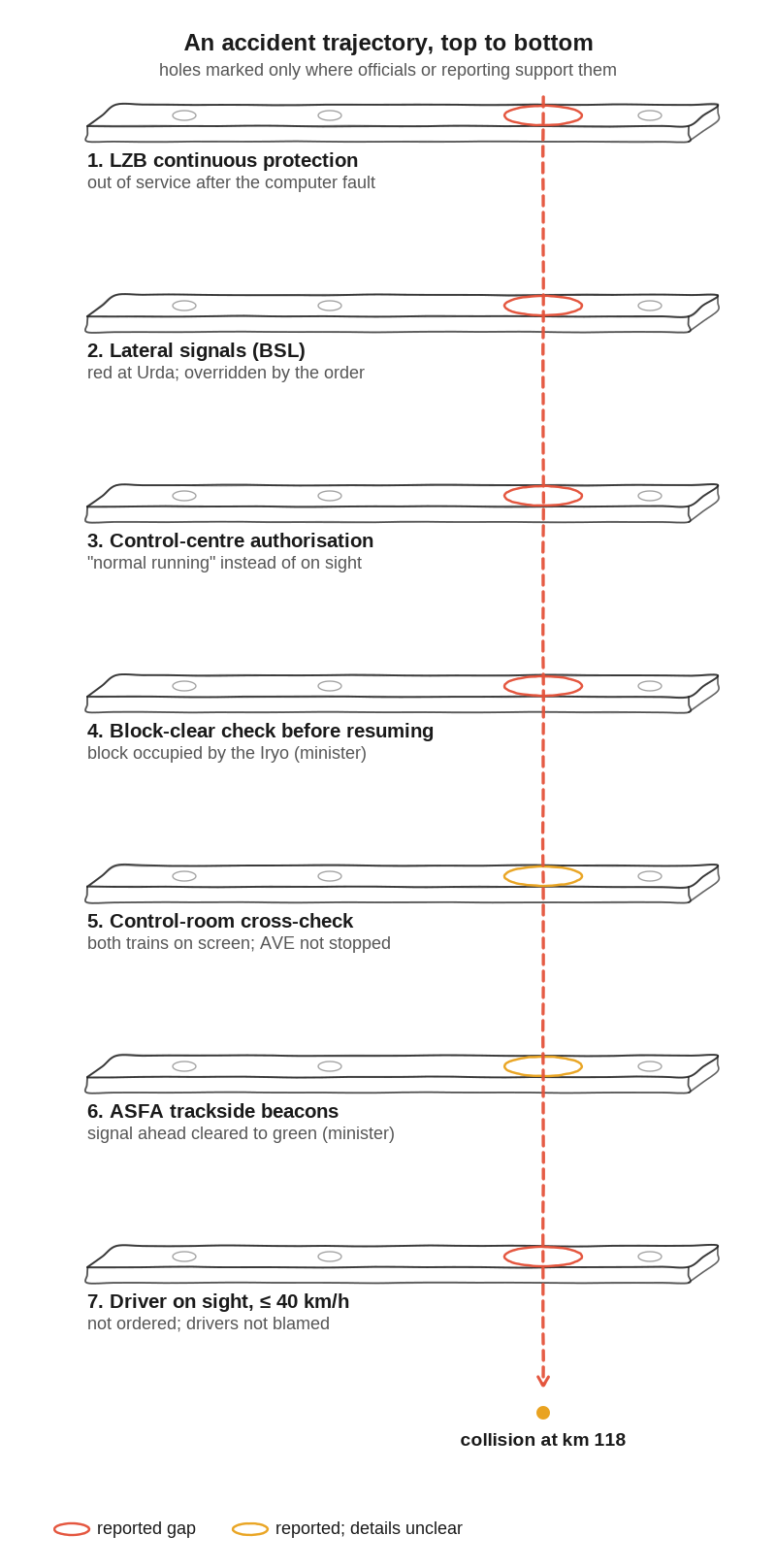
James Reason's Swiss cheese model describes safety as layers of defence, each with holes that open and close. Harm gets through only when the holes briefly line up. Richard Cook says the same in How Complex Systems Fail: "Catastrophe requires multiple failures – single point failures are not enough."
Read the reported sequence that way and the computer fault is only the first hole. The trains stopping shows the next layer working. What came after, by the minister's account, was a restart order that didn't match the written procedure. Then the chances to catch it came and went: a driver on another train challenged the same order, and the Iryo called in to say it was still stuck. As far as reporting shows, neither turned into a stop order for the AVE. With continuous protection gone, the minister says not even ASFA could help, because the Iryo's signal had been cleared to green for a train that never moved. And the control room, by his account, could see both trains on screen the whole time.
Cook has another warning that belongs right here: "Hindsight biases post-accident assessments of human performance." Knowing the outcome makes the right call look obvious. It rarely looks that way in a busy control room during a fault. That's why the question investigators ask isn't "who got it wrong" but "what made this action make sense at the time".
The recovery path is the least tested path
Lisanne Bainbridge described this in 1983. In Ironies of Automation she argued that automation takes over the routine work and leaves people the hardest jobs: taking over when something has already gone wrong. Their skills fade because they rarely use them. Her conclusion: "one can argue that the operator needs to be more rather than less skilled, and less rather than more loaded, than average."
Nancy Leveson's Engineering a Safer World frames safety as a control problem. Accidents happen when a controller issues a command that is unsafe for the real state of the system, often because its picture of that state has drifted from reality. Degraded mode is where that drift is most likely. The automation that kept the picture accurate is the thing that just failed.
The general lesson is uncomfortable. Normal running happens thousands of times a day and is superbly tested. Restarting traffic manually after a protection failure happens rarely, under pressure, with the strongest safety layer missing. The recovery path is the least exercised path in the system, and it runs with the fewest guard rails.
Make the safe restart the default
A few principles follow, for any system that fails safe and then needs people to bring it back:
- The degraded-mode default should be the cautious one. Driving on sight at 40 km/h should be what a restart means, not an option someone has to remember to say.
- Overriding a stop should need an independent check. The section-clear condition is the right idea. It works best when a second person or the system itself has to confirm it, not just recall it. The one bright spot reported so far is that on another train, a driver questioned the order and set off on sight. That's the second check working, but as far as is known it didn't reach the order already given to the AVE. A check only protects you if what it finds is applied to everything already in motion.
- Rehearse the restart. If manual recovery is rare, practise it, the way Bainbridge recommended simulator time for rare failures.
- Give the people in the loop the same picture the automation had, and make the system act on it. By the minister's account, Atocha's screens did show both trains in the same block. A picture someone has to notice isn't a safeguard. If the panel shows a train in the section ahead, the restart procedure should refuse to proceed without an explicit, recorded override.
Why software people should care
We build the same shape constantly. A circuit breaker trips, a deploy halts, a database fails over. Then someone has to "resume", usually by hand, often by bypassing the very guard that stopped things. Knight Capital lost more than $460 million in 2012, and its improvised fix during the incident made the problem worse. I wrote about that in Is Your Ego Running Production?.
The stakes in Urda are of a completely different order, and I don't want to blur that. But the engineering lesson carries over. Design the recovery path as carefully as the happy path. Make the safe restart the default. Require a second check before anyone overrides a stop. And when it goes wrong, look at the system before the person.
What Urda does and doesn't say about AI & Automation
One fact first, because it will get lost. Nothing reported so far suggests AI played any part in this. LZB and ASFA are conventional railway signalling: deterministic train protection built to fixed rules (El País). Nobody was running a model.
I still expect Urda to be pulled into the AI debate, so it's worth getting the argument right. It goes like this: as automation becomes more capable, people lose the skill and context to take over when it fails. So slow down, and keep humans firmly in control until we know they can catch the machine.
That argument deserves a fair hearing, because it rests on real work. Bainbridge put it sharply: "the designer who tries to eliminate the operator still leaves the operator to do the tasks which the designer cannot think how to automate." Parasuraman and Riley described how people come to over-rely on automation and stop monitoring it, and how designers sometimes treat the operator's role as a by-product of the automation (Human Factors, 1997). Sarter and Woods documented "automation surprises", where crews lose track of what the system is doing and why (Human Factors, 1997). And automation can be the hazard itself. The US House transportation committee found that "faulty assumptions about pilot responses" were among the causes of the two Boeing 737 MAX crashes, which killed 346 people (House report, 2020).
I take all of that seriously. I just think it points the other way.
Look at what failed at Urda, on the account we have today. The automation did its job: it lost its data and stopped every train. What failed, according to the minister and the investigators' first note, was the manual path: a chain of instructions and actions in which a human authorisation didn't match the written rule. The weak link wasn't the sophisticated machine. It was the assumption that a person can always step in safely.
That assumption has a poor record. On Air France 447 in 2009, iced airspeed probes caused the autopilot to disconnect. The French investigators, the BEA, found the crew never identified the approach to the stall or the stall itself, and 228 people died (BEA final report). In Tempe in 2018, Uber's test vehicle detected a pedestrian 5.6 seconds before impact but never classified her correctly. Its design relied on the safety operator, not the system, to brake in an emergency. The NTSB found the operator was distracted by her phone and called it "a typical effect of automation complacency" (NTSB HAR-19/03). In both cases "a human takes over" was the safety plan, and it failed.
Bainbridge saw the trend coming too: "it is the most successful automated systems, with rare need for manual intervention, which may need the greatest investment in human operator training." The better the automation, the harder the handover. Slowing down doesn't fix that. Only designing the handover does.
The status quo has its own body count, too. The WHO estimates 1.19 million people died on the world's roads in 2021 (WHO, 2023). Waymo researchers compared 56.7 million miles of driverless operation against human drivers in the same cities. They found statistically significant reductions in injury, airbag-deployment and serious-injury crashes (Kusano et al., 2025). The authors work for Waymo, and it covers a few cities, so read it as evidence, not proof. But it is peer-reviewed evidence that every year of delay has a cost, and that cost is counted in lives too.
Responsible acceleration
I'm openly an accelerationist. I want AGI and ASI as soon as we can build them. To me Urda is a case for faster, better engineering, not for slower progress. That means treating the handover as a first-class system, not a footnote:
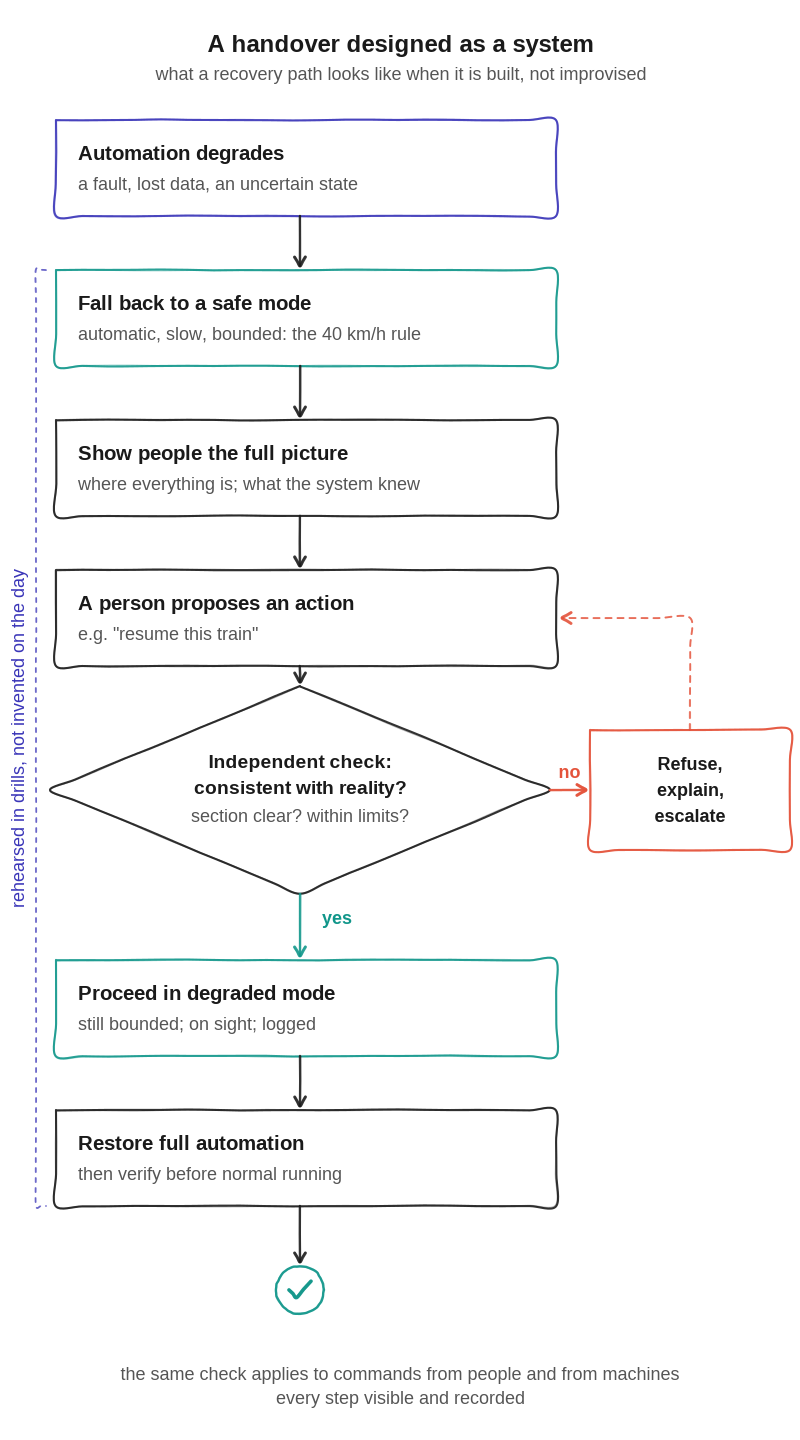
- Degrade gracefully, and by default. When capability drops, the system should fall into a bounded, slower mode on its own. The 40 km/h rule belongs in the machine, not in someone's memory.
- Check every override independently. A separate check should be able to refuse an unsafe command, whether it comes from a person or a model.
- Make the state visible. Whoever takes over needs what the system knew, not a blank screen and a radio.
- Rehearse recovery. Test the manual path as often as the happy path. Drills, game days, simulators.
- Let capable automation be the fallback where it can. A tired human at the worst possible moment is not a safety guarantee. Better automation often is.
None of this is exotic. It's what aviation, nuclear and the better software teams already do on their best days. The lesson of Urda isn't "fear capable machines". It's "never trust a fragile handover", whoever or whatever sits on either side of it.
We'll know much more when the investigators report. Until then, the right posture is patience, and respect for the people who lost their lives.
Sources
- Euronews, 'Inexplicable' order by control centre investigated, 28 Oct 2026
- Reuters, How a high-speed train crash unfolded in central Spain, 28 Oct 2026
- AITAT first note, as reported by elDiario.es: El primer informe sobre el accidente de Urda estima que la colisión… se produjo a "entre 160 y 200 km/h" (Spanish), 29 Oct 2026
- ABC, El primer informe de Urda apunta a una «cadena de averías e instrucciones» (Spanish), 29 Oct 2026
- Cadena SER, La AITAT recupera las cajas negras de los trenes de Urda (Spanish), 29 Oct 2026
- Euronews (Spanish), El primer informe técnico de Urda apunta a una "cadena" de fallos, 30 Oct 2026
- EFE, Se mantienen los 69 fallecidos en el accidente de Urda (Spanish), 30 Oct 2026
- Euronews (Spanish), Las autoridades no descartan más víctimas en Urda, 30 Oct 2026
- CLM Press, Page afirma que 24 de los fallecidos viajaban en el AVE y 44 en el Iryo (Spanish), Oct 2026
- El País, Las llamadas entre Atocha y los maquinistas… explicadas frase a frase (Spanish), 30 Oct 2026
- El País, El operador que autorizó al AVE a retomar la marcha se acoge… a su derecho a no declarar (Spanish), 30 Oct 2026
- El Confidencial, El operario de la Sala de Control… único investigado por ahora (Spanish), 30 Oct 2026
- RTVE, Puente descarta dimitir e insiste en una cadena de errores en el Centro de Control (Spanish), 30 Oct 2026
- RTVE, La Comisión de Accidentes Ferroviarios advirtió en 2025 de "carencias sistémicas"… (Spanish), 30 Oct 2026
- laSexta, Puente asegura que el AVE vio un semáforo "verde" antes de chocar (Spanish), 30 Oct 2026
- El Español, Los controladores de Adif culpan a Puente (Spanish), 30 Oct 2026
- elplural.com, Vox mantiene su agenda política mientras el resto de partidos guardan respeto (Spanish), Oct 2026
- Servimedia, Feijóo retomará la campaña el lunes (Spanish), 30 Oct 2026
- El País English, What is the LZB signaling system, 28 Oct 2026
- La Vanguardia, Puente ve "inexplicable"… (Spanish), 28 Oct 2026
- Euronews (Spanish), Óscar Puente considera "inexplicable"…, 28 Oct 2026
- EFE, El tren Iryo accidentado viajaba con 147 pasajeros y el AVE con 397 (Spanish), 28 Oct 2026
- El Español, Puente… reconoce que no había ningún sistema de seguridad que impidiera un error humano (Spanish), 28 Oct 2026
- Cadena SER, Audios: "Reanude con marcha normal" (Spanish), 28 Oct 2026
- Cadena SER, La maquinista de Iryo llamó al centro de control… (Spanish), 28 Oct 2026
- El País, Los cabos por atar del siniestro de Urda (Spanish), 29 Oct 2026
- Consejo General del Poder Judicial, La jueza instructora… acuerda la prohibición de acceso (Spanish), 28 Oct 2026
- RTVE, Qué es el sistema LZB y cómo funciona (Spanish), 29 Oct 2026
- Europa Press, El reglamento de Adif prohibía… (Spanish), 28 Oct 2026
- La Moncloa, Three days of official mourning (Spanish), 28 Oct 2026
- James Reason, Human error: models and management, BMJ, 2000
- Richard Cook, How Complex Systems Fail, 1998
- Lisanne Bainbridge, Ironies of Automation, Automatica, 1983
- Nancy Leveson, Engineering a Safer World, MIT Press, 2012
- Raja Parasuraman and Victor Riley, Humans and Automation: Use, Misuse, Disuse, Abuse, Human Factors, 1997
- Nadine Sarter and David Woods, Team play with a powerful and independent agent, Human Factors, 1997
- US House Committee on Transportation and Infrastructure, Final Committee Report: The Boeing 737 MAX, September 2020
- BEA, Final report on Air France flight AF447, July 2012
- NTSB, Collision Between Vehicle Controlled by Developmental Automated Driving System and Pedestrian, Tempe, Arizona (HAR-19/03), 2019
- World Health Organization, Global status report on road safety 2023, 2023
- Kristofer Kusano et al. (Waymo), Comparison of Waymo rider-only crash rates by crash type to human benchmarks at 56.7 million miles, Traffic Injury Prevention, 2025