Recently I've been noticing small changes in how my days are put together. None of them arrived with an announcement. There was no day when I decided to work differently. But when I look at a week of mine now and compare it with a week from three years ago, the shape is different.
A lot has been written about what AI coding agents do to code. Whether the code is good, whether review can keep up, whether juniors still learn. I've written some of that myself. Much less has been written about what they do to the person. To the chair, the evening, the bank statement and the people at the dinner table.
So this post is about that. I don't have a strong argument to make here, and I'm not trying to warn anyone off. I use coding agents, cloud agents and a handful of Grok Bots every day, and I like it. I just want to look at what has moved, and offer a few thoughts on what might help.
The Desk
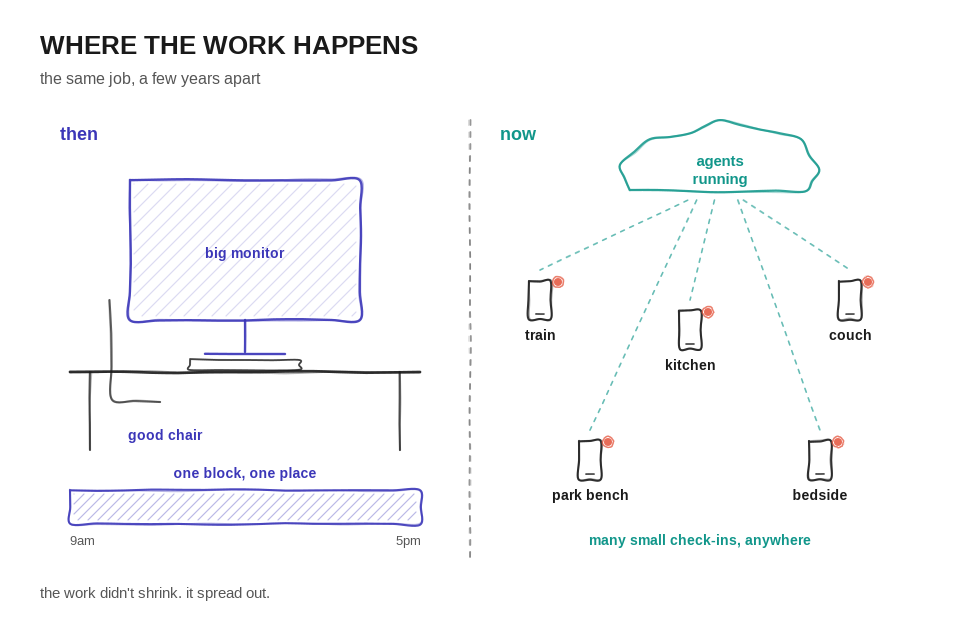
For most of my career, the desk was the centre of the job. I've been writing software for about eighteen years, a good chunk of it Python and Django, and for nearly all of that time being productive meant being in one place.
We cared about that place. We argued about monitors. We bought the chair we couldn't really afford because we'd sit in it for ten thousand hours. We set up two screens, then one big one, then went back to two. We learned keyboard shortcuts so our hands didn't have to leave the home row.
All of that made sense, because the work happened at the speed of our hands. If you were typing the code, the ergonomics of typing mattered more than anything else.
That has quietly stopped being true for a lot of what I do. When an agent is writing most of the first draft, my hands are not the bottleneck. My attention is. And attention doesn't need a desk.
The tools have noticed this too. When Cursor launched its iOS app in June, the announcement said developers had been "keeping laptops half-open and caffeinated everywhere they go," and pitched launching agents "whether you're catching a flight, cooking a meal, or in between sets at the gym." It describes push notifications and lock-screen updates when an agent finishes, needs input or is ready for review, and merging the pull request from your phone.
I don't say that as a complaint. It's genuinely useful. Kicking off a fix from the train while it's fresh in my head is a nice thing to be able to do. But it does mean the desk is no longer where the work lives. It's one of several places.
The New Ergonomics
So the old ergonomics questions, about chairs and monitor height, haven't gone away. They've just been joined by new ones that we haven't really thought about yet.
The first is physical. I now read diffs on a phone. I review screenshots an agent took of a UI change while I'm sitting on the couch, head bent forward, thumb scrolling. We spent years telling each other to put the top of the monitor at eye level. Then we started doing a meaningful part of the job looking down at a small screen held at chest height. I'm not a physiotherapist and I won't pretend to know the numbers, but I'm fairly sure my neck has an opinion about it.
The second is attention. Working with agents is less like writing and more like supervising. You start something, step away, come back, read, decide, start the next thing. Each of those returns is a small context switch.
Gloria Mark and her colleagues studied this long before agents existed. In a 2005 study of information workers, interrupted work that was resumed the same day took an average of 25 minutes and 26 seconds to get back to, and in between people worked on an average of 2.26 other tasks. That study was about phone calls and colleagues at the door. A day of agent check-ins can produce a lot more of those returns than a day of phone calls ever did.
The third is a kind of reading fatigue. When you write code yourself, you build the understanding as you go. When an agent writes it, you have to build the understanding afterwards, by reading. Reading someone else's code all day is tiring in a different way from writing your own. I notice it as a heaviness by mid-afternoon that I didn't used to have, even on days when I've typed almost nothing.
I think we need ergonomics for this too. Not just a good chair, but a good rhythm. Fewer, longer check-ins rather than many tiny ones. Reviewing on a real screen when the change matters. Treating the phone as a place to start and steer work, not a place to approve it.
The Agents Don't Sleep
This is the part I think about most.
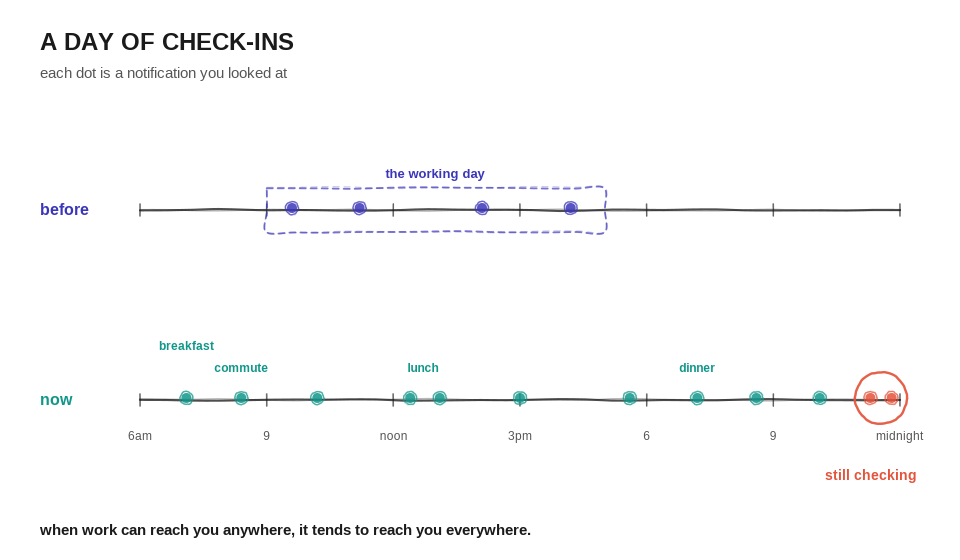
A cloud agent doesn't get tired. A Grok Bot running an errand at 11pm doesn't mind. That's a feature. You can hand off a job at the end of the day and wake up to a result. But it also removes something that used to protect us: the work stopping because we stopped.
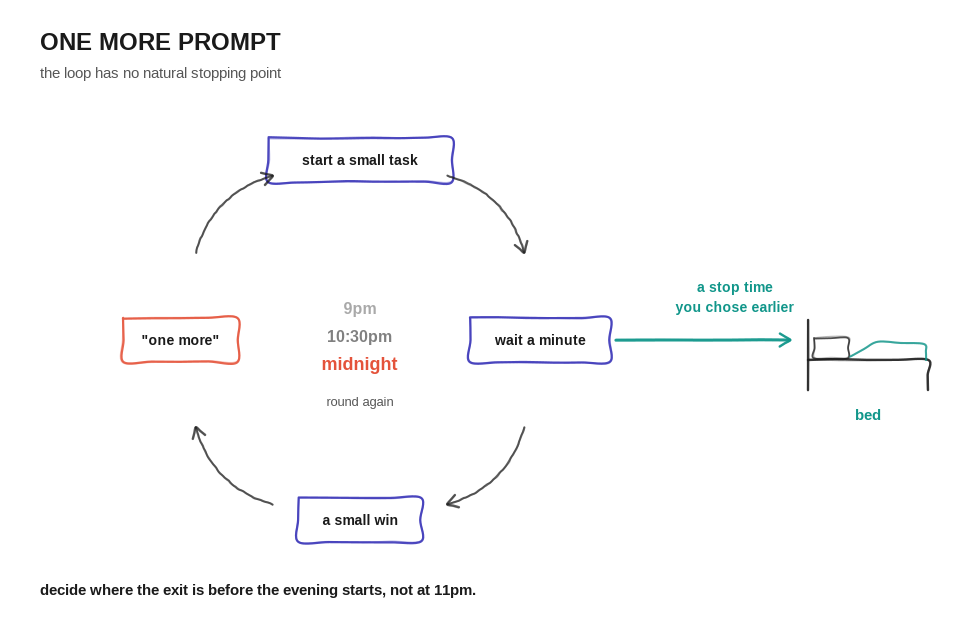
When I wrote all the code myself, there was a natural end to the day. I'd get stuck, or tired, or my brain would simply refuse to hold one more thing. Now there's always one more small thing I could kick off. It only takes a minute. It'll be done by morning.
I'm clearly not the only one who feels this. LeadDev ran a piece in April called The "just one more prompt" era is here, in which Kelli Korducki spoke with nearly a dozen developers who described a "slot machine" effect, and several said they'd scrambled their sleep schedules. One founder told her, "Earlier, you'd stop because you got stuck. Now you just keep moving." Another said he'd skip sleep because he "hadn't used up my full daily limits on the tools yet, like I was leaving potential on the table."
That last line stuck with me, because I recognised it. When you pay for a usage allowance that refreshes, unused capacity starts to feel like waste. It's a strange new pressure, and I don't think it's a healthy one.
Quentin Rousseau wrote a very honest post called One More Prompt: The Dopamine Trap of Agentic Coding, about lying in bed with "the prompts" still "composing themselves behind my eyelids." He tried batching agent runs instead of watching them in real time, and tracking hours instead of output. He's candid that he still breaks his own rules.
What I find interesting is that the advice in both pieces is very old-fashioned. A hard stop time. Laptop closed by a certain hour. One of the founders in the LeadDev piece set a rule of "Laptop closed by 6pm, no exceptions," and said that, ironically, the work didn't suffer. It improved.
None of this is new wisdom. What's new is that the tool no longer enforces it for us. The friction that used to send us to bed is gone, so we have to put it back on purpose.
The People Around Us
Time is the obvious cost. The less obvious one is presence.
Being physically at the dinner table while half-watching an agent finish a migration is not quite the same as being there. I've caught myself doing it. Nobody minds a quick glance. But a quick glance every ten minutes adds up to an evening where I wasn't really in the room.
There's something a little lonely about agent work too, which I didn't expect. A lot of my day used to involve other people by necessity. You'd ask someone how a module worked, or pair on a hard bug, or wait for a colleague's review and chat while you waited. Now much of that conversation happens with a model. It's fast and patient and available at any hour. It also doesn't ask how your weekend was.
I don't want to overstate this. There are new social forms emerging as well. People share their agent setups, swap prompts, show each other what they've built on a Saturday. Some of the most fun conversations I've had with other engineers this year were about how we each organise our bots. That's real connection, and it's nice.
But I think it's worth noticing which human contact has been quietly replaced, and choosing to keep some of it on purpose. Ask the colleague, even when the agent could answer. Pair on the hard thing. And when you're with your family, put the phone in the other room. The agent will still be there, and so will the pull request.
Everybody Is Shipping
There's another feeling I've noticed in the last year or so, and I think many developers share it. It's the sense that everyone around you is building something.
Open any feed and somebody has shipped an app over the weekend. Somebody else has three side projects live. A friend who had never made a mobile app has one in the store. It's exciting, genuinely. A lot of ideas that would never have been built are being built.
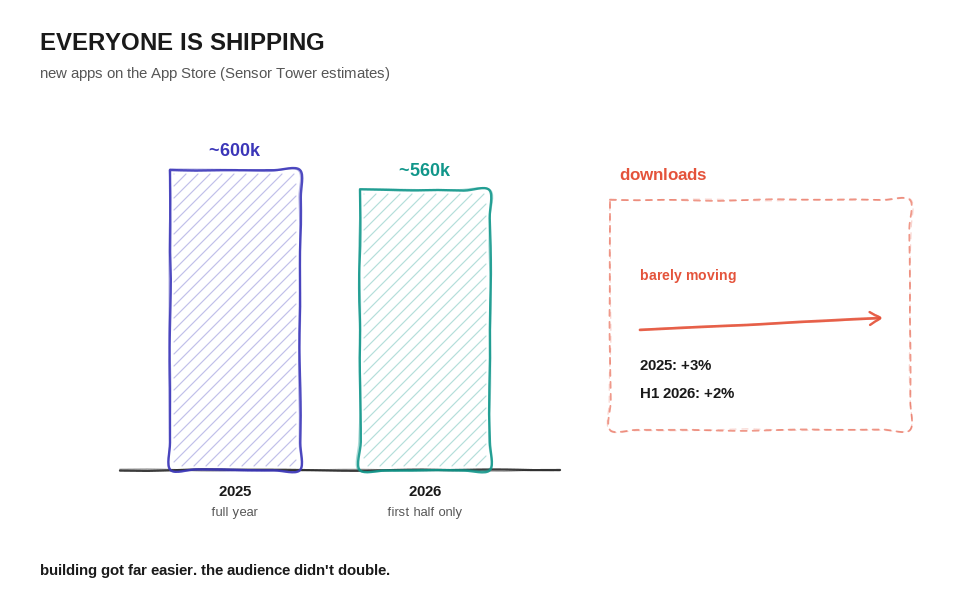
The numbers back up the feeling. GitHub's Octoverse 2025 report said more than one new developer joined GitHub every second on average, over 36 million in a year, and that developers created more than 230 new repositories every minute. And as 9to5Mac reported in July, citing Sensor Tower estimates via The New York Times, new App Store releases grew about 30 percent in 2025 to around 600,000, and then roughly 560,000 new apps arrived in the first half of 2026 alone.
The same report has a detail I keep coming back to. Downloads grew 3 percent in 2025 and 2 percent in the first half of 2026. Building has become far easier. Attention hasn't grown to match it.
I think this explains a lot of the pressure people feel. When everyone is working hard, and everyone can produce a lot, the bar for what counts as keeping up moves every month. You ship something, and the next week three similar things appear. So you reach for the next thing. And the next.
Chuck, a security architect in the LeadDev piece, put it plainly. He wants to find the great idea first because "three or six months from now, somebody else will." I understand that. I've felt it. But I'm not sure it's a race anyone can win, because the finish line moves at the same speed as the runners.
What "Done" Means
This leads to a quieter question. What does it mean for something to be finished now?
When building took months, finishing was a big moment. You'd launch, you'd maintain, you'd live with the thing for years. Now it's easy to build something in a weekend and move on before it has really been used. I've got a few of those myself, and I'm fond of them. But a project that's been built isn't the same as a project that's been cared for.
I've started to think the scarce thing is no longer the ability to make something. It's the patience to stay with it. To answer the third bug report. To make the boring improvements. To let something be small and useful rather than chasing the next launch.
That's an old Django-world lesson, really. The projects that lasted were rarely the cleverest ones. They were the ones somebody kept looking after.
The Subscription Line
Now to money, which is where the change is easiest to measure and, I think, the strangest when you look back.
I remember thinking carefully about paying for an editor. In 2013, Sublime Text raised its licence price from $59 to $70, the first rise in its five-year history, and I remember that being a conversation. In 2015 a personal PyCharm Professional licence was $89 for the first year. I know developers who used the free editions for years rather than spend that. I was one of them for a while.
Then in February 2023 OpenAI launched ChatGPT Plus at $20 a month, and I remember people debating whether that was too much. Twenty dollars a month felt like a real decision.
In December 2024 OpenAI introduced ChatGPT Pro at $200 a month. Today its Pro tiers run at $100, $200 and $500. Anthropic's Claude pricing lists Max at $100 and Ultra at $200 a month. Cursor's plans go up to Ultra at $200 a month. Google cut its top AI Ultra tier from $250 to $200 in May and added a $100 one. And xAI launched SuperGrok Heavy at $300 a month back in 2025. Those are US prices, before tax.
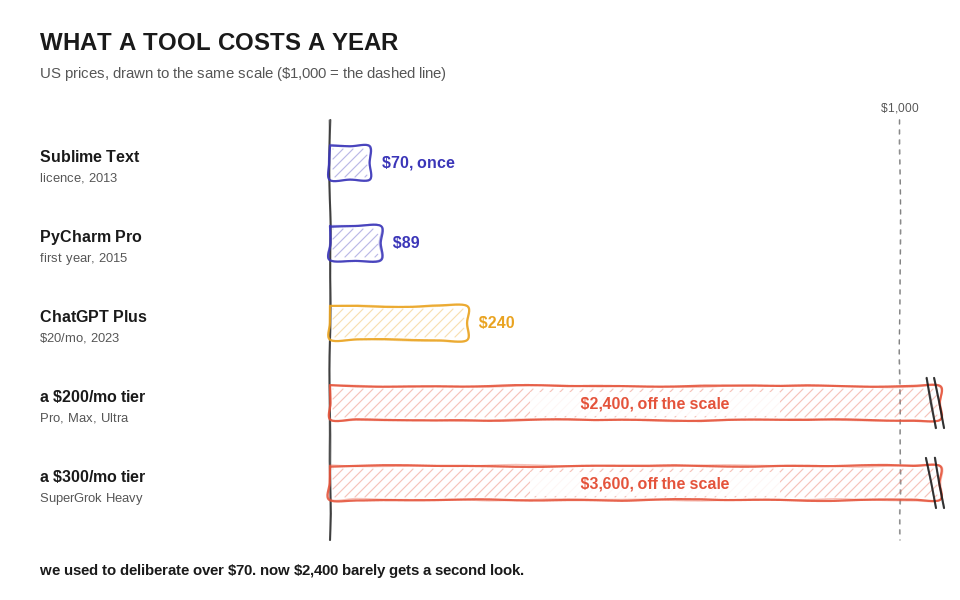
What I find remarkable isn't that the prices are high. It's how quickly they started to feel normal. A few years ago I'd have laughed at a $200 monthly tool. Now, when I hear another developer is on one of the top tiers, it barely registers. So does everyone, it seems.
Who Gets to Pay
I don't think the normalisation is irrational. At $200 a month, one of these plans adds up to $2,400 a year. If it saves you a few hours a week, the maths is easy. A lot of people now talk about these tools the way companies talk about a salary line: not "is this expensive?" but "what does it replace?"
But a few things make me a little uneasy.
The first is stacking. Each subscription makes sense on its own. A coding agent plan, a chat plan, a bot plan, the usage top-ups when you hit a limit on a busy week. It's very easy to end up paying for three overlapping tools because each was the best at one thing for a month. I'd encourage anyone to sit down once a quarter and look at the whole list, the way you would with streaming services.
The second is the allowance pressure I mentioned earlier. A plan with a weekly pool that refreshes nudges you to use it all, which nudges you to keep working.
The third is fairness. Eighteen years ago, a student with a cheap laptop and a free editor had more or less the same tools as a senior engineer at a big company. That was one of the lovely things about this profession. A $200 a month tier is a very different amount of money depending on where you live and what you earn. I'm glad most of these companies still offer cheaper and free tiers. I hope that stays true, and I hope those of us who can afford the top plans remember that not everyone can.
Habits Worth Keeping
So what do we do with all this? I don't think the answer is to go back. I'm not going to give up the agents, and I don't think anyone should feel guilty for enjoying them. They've made a lot of my work more fun.
But I think it helps to be deliberate about the habits that used to be enforced for us and now aren't.
The desk used to tell us when we were working. Now we have to decide that ourselves. I've started treating it as a choice again: real work at a real screen, steering from the phone only when it's genuinely useful.
Getting tired used to tell us when to stop. Now we have to choose a stop time before the evening starts, because by ten o'clock the loop will always have a good reason to continue.
Colleagues used to be part of the day by necessity. Now we have to keep them in it on purpose.
And money used to be scarce enough that we thought about every tool. Now it's worth thinking about them again, once in a while, all together.
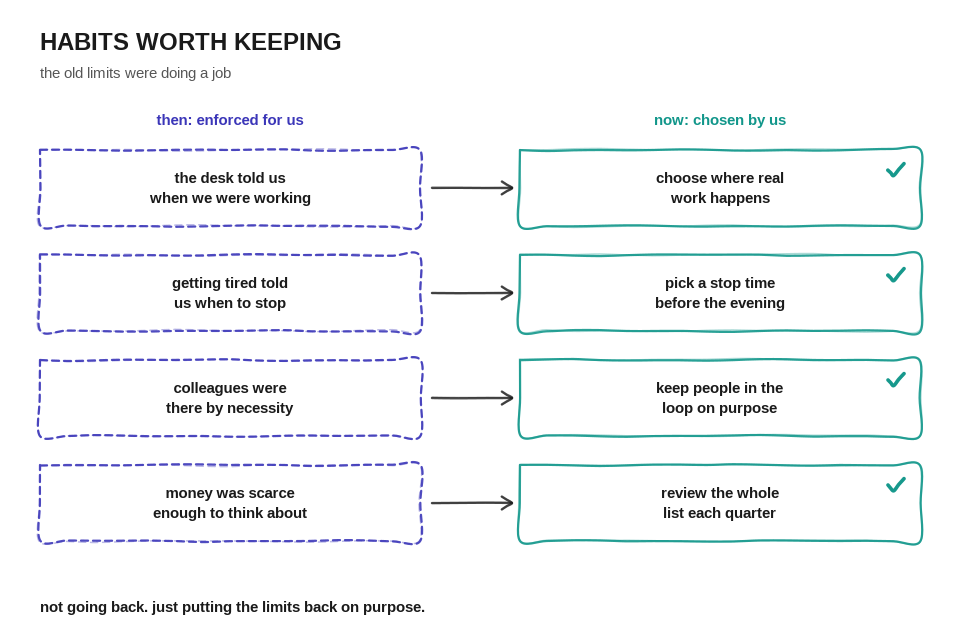
None of this is dramatic. It's just a rearrangement, the kind you only notice when you step back and look at a whole week at once. I'd be curious whether other developers see the same shape in their own days, and what habits they've found that help.
I suspect we're all still working it out.