"AI data centers will destroy the planet."
I keep hearing this. And I disagree.
Not because the concerns aren't real. They are. Data centres use water. They use electricity. They take up land. All true, and I'll put numbers on each of them below.
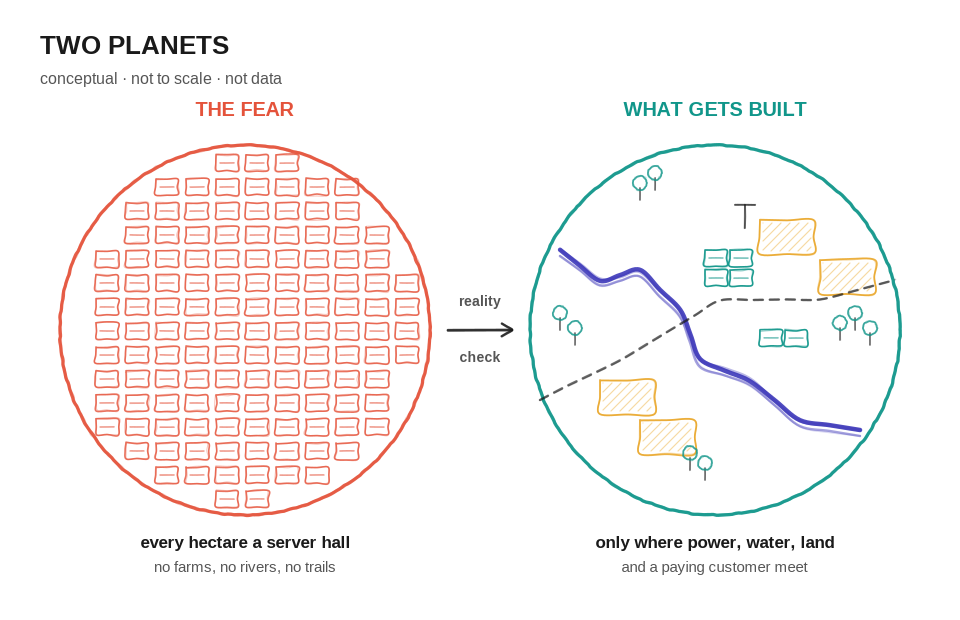
But the doom version of the argument stretches those truths far beyond their proportion. It imagines a straight line going up forever: more chips, more halls, more cooling towers, until the server farm is the planet.
That isn't how infrastructure has ever grown. And it isn't how this will grow either.
First, the honest numbers
I want to start with the facts, because an optimist who skips them isn't an optimist, just someone who hasn't looked.
The International Energy Agency's Energy and AI report estimates that data centres used around 415 TWh of electricity in 2024, about 1.5% of the world's electricity. Their consumption has grown about 12% a year since 2017, and the IEA's base case projects it to more than double to around 945 TWh by 2030. That last number is a projection, not a measurement, and the IEA's own range for 2035 spans 700 to 1,700 TWh depending on how fast AI is adopted and how quickly efficiency improves. [1]
So yes, it's growing fast. But the same report also says data centres account for around a tenth of global electricity demand growth to 2030, less than industrial motors, air conditioning or electric vehicles. [1]
The bigger story is local. In the United States, Lawrence Berkeley National Laboratory estimates data centres used 176 TWh in 2023, 4.4% of the country's electricity, and projects 6.7% to 12% by 2028. [2] The IEA notes nearly half of US data centre capacity sits in five regional clusters. [1] A global share of 1.5% can still mean a very large share of one town's grid.
On water, the same LBNL report estimates US data centres directly consumed about 66 billion litres in 2023, mostly for cooling, plus nearly 800 billion litres consumed indirectly through the power stations that generated their electricity. [3]
Those are real numbers. They deserve engineering, not denial. They also don't describe a planet turning into a server farm.
Infrastructure has always had a governor
Look at how the big infrastructure waves actually went.
Electricity arrived and wires went up everywhere. Streets, highways, suburbs, countryside. Roads followed the same story, from the Roman network and the Silk Road to concrete highways. Each wave changed the landscape. Each one cut down trees and altered rivers and habitats. I'm not going to pretend otherwise.
But farming still happens. Water still flows. People still hike. Planes still take off and land. We didn't fill the earth with power lines or pave the whole planet. We built enough to be useful, and then the building slowed.
Why? Because every one of these things has to be paid for, powered, permitted and placed somewhere. Nobody builds a road to nowhere, because somebody has to pay for it. That constraint is the governor on the engine.
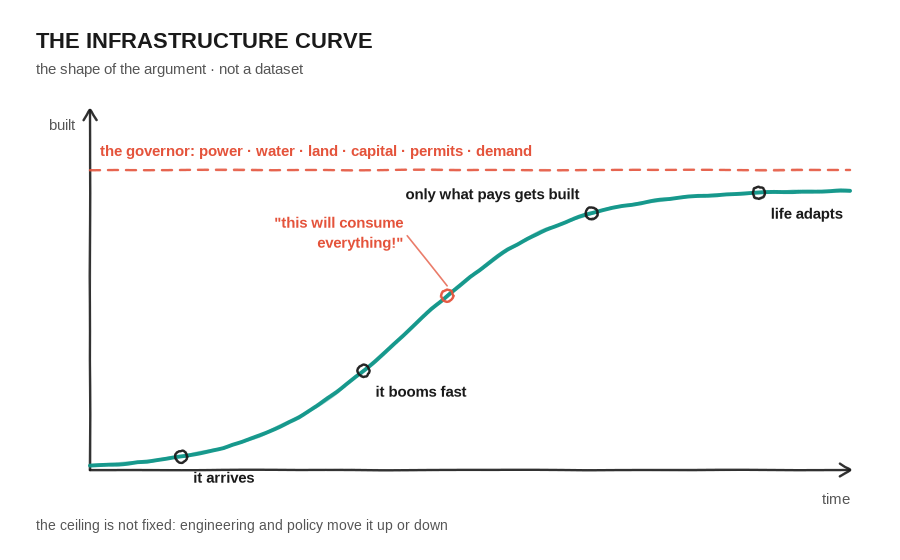
Data centres have this governor built in, and it's already biting. The IEA estimates around 20% of planned data centre projects could be delayed by grid constraints, with new transmission lines taking four to eight years in advanced economies and lead times for transformers and cables doubling in three years. [1] A data centre without a grid connection is an expensive shed.
I want to be precise about what the governor does and doesn't do, though. Economics limits how much gets built. It does not guarantee that what gets built is a good investment. Booms overshoot. Some projects will lose money, and some regions will get more than they needed for a while. The claim I'm making is narrower: physical and financial limits stop the expansion long before "everything". They always have.
"Data centres waste water"
This is the argument I hear most, and I think it's both right and wrong.
Here's what's right about my instinct. The water on this planet isn't going anywhere. It cycles: ocean, atmosphere, rain, ground, river, ocean again. A data centre does not delete water from the Earth.
Here's what that instinct misses. Hydrologists don't measure water use by whether water leaves the planet. The US Geological Survey defines consumptive use as the part of withdrawn water that is "evaporated, transpired, incorporated into products or crops, consumed by humans or livestock, or otherwise removed from the immediate water environment." [4]
That word immediate is the whole point. When a cooling tower evaporates water in a dry basin in summer, that water really does come back as rain. Just not necessarily there, and not necessarily this year. For the farms and homes drawing on the same aquifer, it's gone.
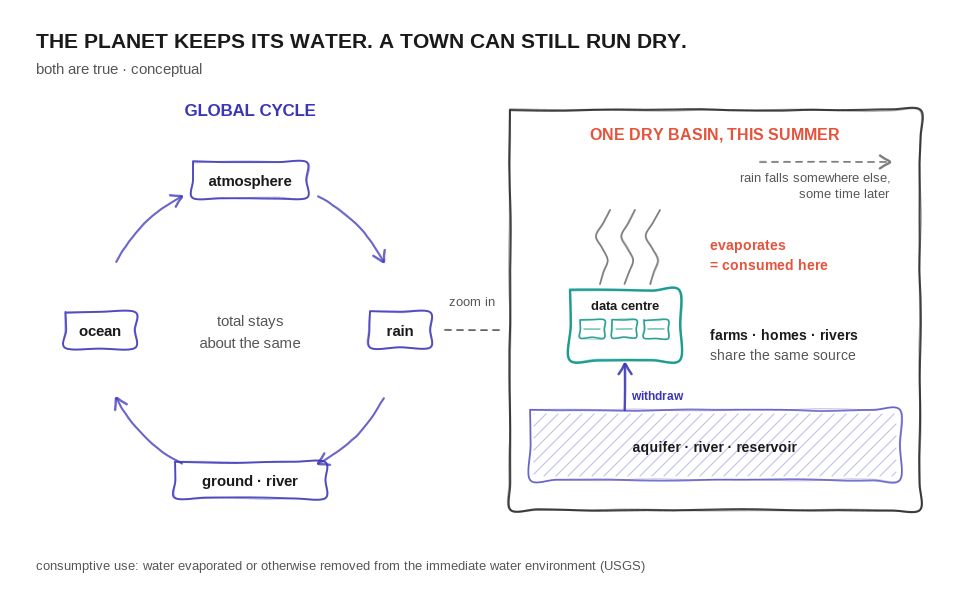
So I'd put my original point more carefully. When people say "wasting water", a lot of what they mean is: water that has moved out of reach, and the energy and infrastructure it would take to bring it back. Water goes to the sea? You can desalinate it. Water goes deep underground? You can pump it. Water is dirty? You can treat it.
Energy is a big part of that cost. It isn't the only part. Desalination leaves brine that has to go somewhere. Pipes, plants and permits take years. Ecosystems depend on rivers actually flowing, not just on the water existing somewhere. Cheap energy makes these problems much easier. It doesn't make them disappear.
The engineering is already moving
The more encouraging part is that the industry is designing its way out of the worst of this, and it's doing so because water scarcity has become a cost, a permitting risk and a reputational risk.
Microsoft says that since August 2024 all its new data centre designs use chip-level, closed-loop liquid cooling that evaporates zero water for cooling. The loop is filled once during construction and recirculated. They estimate it avoids more than 125 million litres a year per data centre, with pilots in Phoenix and Wisconsin from 2026. They're also candid about the trade: replacing evaporation with mechanical cooling means "a nominal increase" in annual energy use. [5]
That trade-off is the honest shape of the whole debate.
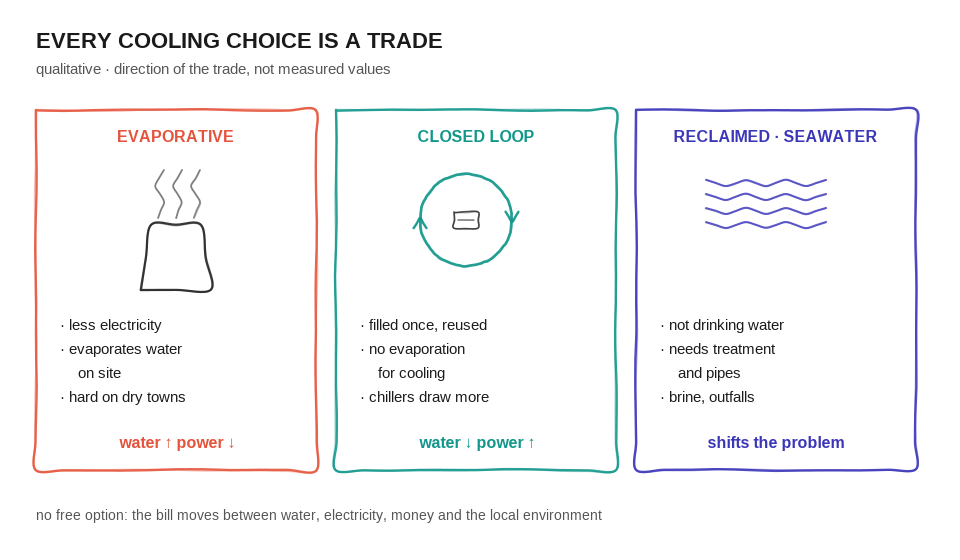
Evaporative cooling saves electricity and spends water. Closed loops save water and spend some electricity. Reclaimed water or seawater avoids drinking water but needs treatment, pipes and somewhere for the brine or warm discharge to go. Where you build decides which trade makes sense. In a wet, cool climate on a clean grid, it's an easy call. In a desert on a gas-heavy grid, it's a hard one.
That's not a reason for doom. It's a reason to site and design carefully.
Where AI helps the energy problem
Now the part I'm genuinely optimistic about.
I don't think data centres only consume energy. I think AI can help us produce more of it, run it smarter and waste less of it. The IEA, which is hardly a cheerleader, lays out some of the opportunities: [1]
→ AI-based fault detection that can cut outage durations by 30–50%.
→ Sensors and AI management that could unlock up to 175 GW of extra transmission capacity on existing lines, more than the base-case increase in data centre load to 2030.
→ Existing AI applications in buildings that, if scaled up, could save around 300 TWh of electricity, roughly the annual generation of Australia and New Zealand combined.
→ Faster discovery of materials for solar, batteries and carbon capture, where only a tiny fraction of candidate materials has ever been made and tested.
Those are potentials, not results. The IEA is careful to say so, and I want to be too. Its own estimate is that broad use of existing AI solutions could cut emissions by an amount equivalent to about 5% of energy-related emissions in 2035. That's far larger than data centre emissions, and far smaller than what climate change needs. In the IEA's words, AI "is not a silver bullet and does not remove the need for proactive policy." [1]
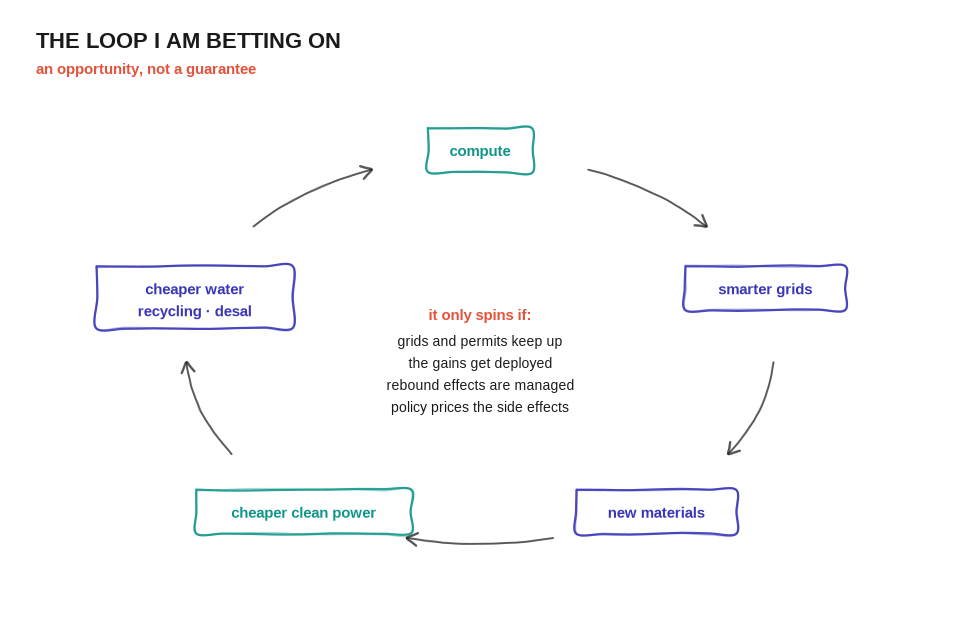
This is the loop I'm betting on: compute helps make energy cheaper and cleaner, cheaper energy makes water easier to recycle and move, and that supports more compute. It isn't automatic. Every arrow in it needs someone to build something, approve something or pay for something.
The market is the governor. It needs a second hand on it.
I still believe the core of my argument. Nobody builds a data centre they don't expect to pay for itself. Nobody strings power lines to empty land. Financial constraint has always limited infrastructure, and it will limit this.
But I've changed one thing in how I say it. The market limits how much gets built. It doesn't automatically count everything that building costs.
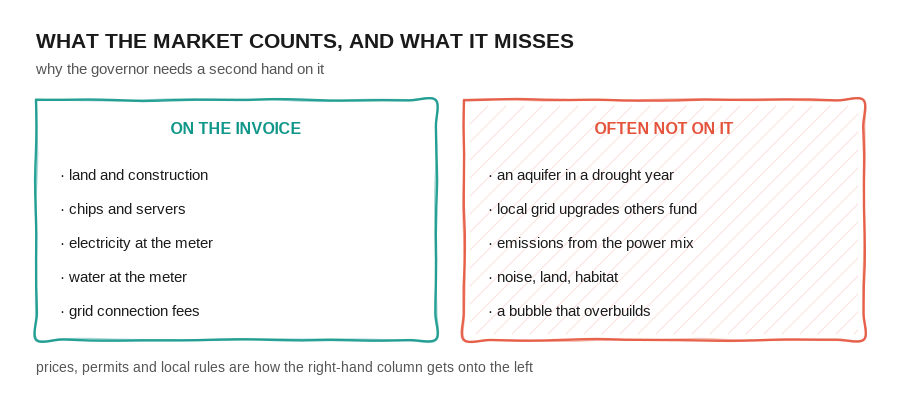
An operator pays for the land, the chips and the electricity at the meter. They don't automatically pay for a drawn-down aquifer in a drought year, a grid upgrade that other customers end up funding, or the emissions of the power mix. Those costs are real, and they only reach the invoice through water pricing, connection rules, planning conditions and disclosure.
That's not an argument against data centres. It's how every infrastructure wave got civilised: roads got environmental reviews, power stations got emission limits, factories got discharge permits. Good rules didn't stop the build. They made it fit.
Where I land
AI data centres are becoming critical infrastructure, like electricity, roads and running water. Saying "data centres are bad for the environment" is a lot like saying "building roads is bad for the countryside". Technically true. Missing most of the point.
So here's my position, as precisely as I can put it.
Will there be growing pains? Yes.
Will there be real environmental impact during the boom, especially in a few concentrated places? Yes.
Will the entire planet become a server farm? No. Power, water, land, capital and permits make sure of that.
Will AI pay back its footprint by making energy and water systems smarter? It can. Whether it does depends on engineering, siting, incentives and governance, not on optimism alone.
The fear is understandable. The doom is disproportionate. We've been here before with electricity, with roads, with every infrastructure leap. We adapted every time, because people did the work of adapting. We'll adapt again the same way.
Where do you stand on the AI infrastructure debate?
Sources
- International Energy Agency, Energy and AI: Executive summary (2025). Figures for 2030 and 2035 are IEA projections and scenario ranges.
- Lawrence Berkeley National Laboratory, Berkeley Lab Report Evaluates Increase in Electricity Demand from Data Centers (January 2025). 2028 figures are scenario ranges.
- Shehabi et al., 2024 United States Data Center Energy Usage Report, Lawrence Berkeley National Laboratory (December 2024), section on water.
- U.S. Geological Survey, Water-use glossary: consumptive use, and the USGS water cycle diagrams.
- Microsoft, Sustainable by design: Next-generation datacenters consume zero water for cooling (December 2024). Company claims, not independent measurements.
All drawings are conceptual illustrations, not to scale and not data.