The cost of the model thinking is nothing compared to the cost of a wrong answer.
Let that sink in for a second, because most of the advice going around right now points the other way.
People are out here choosing faster, cheaper models to save a few cents per query. Turning off extended thinking to shave seconds. Picking the lightweight option because "it's good enough."
Good enough for what?
I've been running AI agents on real production work for six months now. Bugs, incidents, investigations, fixes that go out to real users. And the single biggest lesson I've taken from it is almost boring in how obvious it sounds once you say it out loud: the model's thinking time is the cheapest part of the entire pipeline. Everything else around it, especially the humans, costs far more.
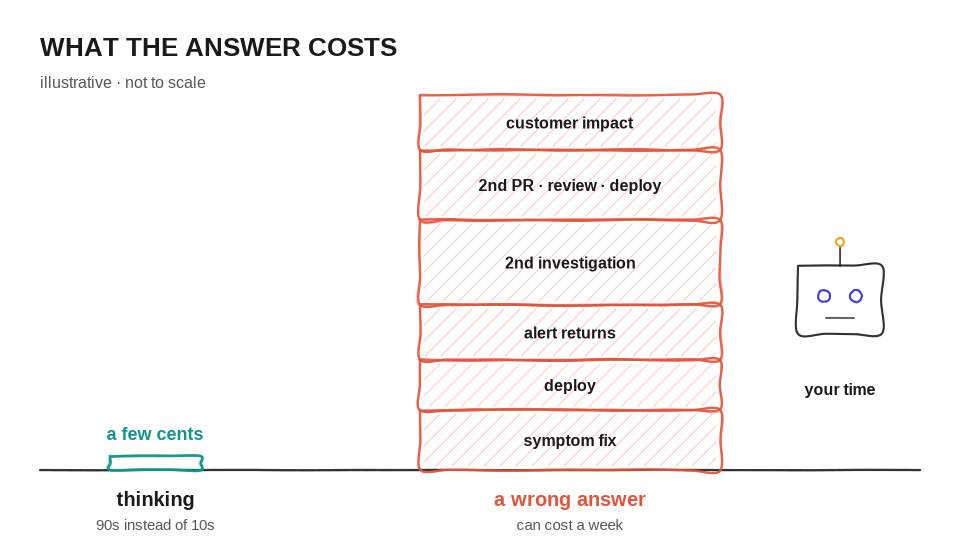
What "saving on thinking" actually costs
Here's the scenario I keep seeing. An agent investigates a production bug. It's running on the fast option, or the thinking budget has been turned down, because the investigation "looked simple". It comes back quickly with a confident root cause. The root cause is wrong.
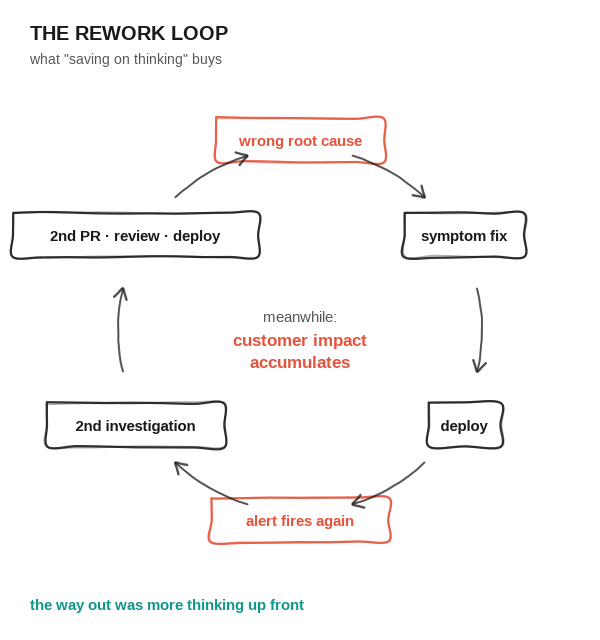
Nothing about that moment feels expensive. The answer arrived in ten seconds. It read well. It sounded sure of itself. The cost doesn't show up there. It shows up over the next several days, one perfectly reasonable step at a time:
→ A fix that addresses the symptom, not the cause.
→ A deploy that doesn't actually fix anything.
→ The same alert firing again three days later.
→ A second investigation from scratch.
→ A second PR, a second review, a second deploy.
→ And whatever customer impact accumulated in between.
What makes this nasty is that every step after the first one is done properly. The fix is well written. The PR is reviewed. The deploy goes out cleanly. The team is doing good work, on the wrong problem. Nobody is being careless. The mistake was made once, at the very top, and everything downstream faithfully inherits it.
And the second investigation is not cheaper than the first. It's usually more expensive, because now you also have to unpick the first theory, explain why the fix didn't work and convince yourself the new answer isn't another confident guess.
Now put that next to what you saved. The "expensive" model that took 90 seconds to think instead of 10? It would have cost you about $0.30 more.
The wrong answer cost you a week.
Let me put actual numbers on this
These are the rough numbers I work with. They're not precise, and they don't need to be, because the gap is so wide that precision doesn't change the conclusion.
→ A senior developer's time: $80-150/hour.
→ A production rollback: 2-4 hours of team time.
→ A wrong root cause that sends you down the wrong path: half a day, minimum.
→ Extended thinking on the best available model: a few cents. Maybe a dollar for a complex investigation.
Do the simple arithmetic on just one of those lines. Half a day is about four hours. At $80-150 an hour, that's roughly $320-600 of one senior developer's time, and that's the minimum, for one person, before anyone else gets pulled in. A rollback is 2-4 hours of team time, so multiply by however many people are in the room for it.
On the other side of the ledger: a few cents. Maybe a dollar.
Even in the most generous framing for the cheap option, a dollar of thinking against a few hundred dollars of one person's half day is a difference of hundreds of times. Stretch that out to the week the wrong answer actually cost, and it isn't worth doing the division.
The economics aren't even close.
And yet people optimise for the cheapest part.
It's like buying the cheapest tyres for a race car. You saved $200 and lost the race. The tyres were never the expensive bit. They were just the bit with a price tag you could see.
That's the trap, I think. Token costs show up on a dashboard, itemised, per query, with a nice graph. The cost of a wrong answer doesn't show up anywhere. It's spread across calendars, standups, a re-opened ticket, a slightly annoyed customer. So people trim the line item they can see and quietly pay the one they can't.
The question that changed my approach
For a while I picked models the way most people do. Which one is cheapest for this? Which one is fast enough? Can I get away with the small one here?
Then I flipped the question. I stopped asking "which model is cheapest?" and started asking:
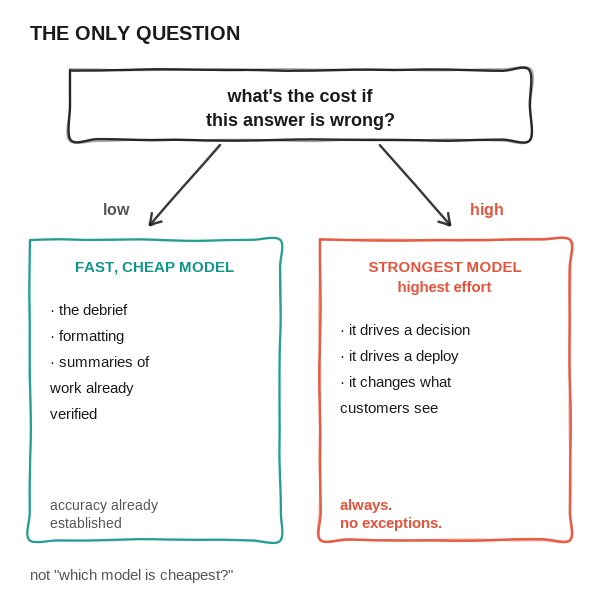
"What's the cost if this answer is wrong?"
That one question sorts almost every task I give an agent. Here are three from my real work, and all three get the same treatment.
Investigating a concurrency bug in a connection pool that's causing auth failures. That's a top-tier model with max reasoning. Non-negotiable. Concurrency bugs are exactly where a plausible story is easy to tell and hard to verify. Get it wrong and you ship a fix for a race that isn't the race.
Tracing a content visibility leak across three API layers. Same. Full power. A visibility leak means someone is seeing something they shouldn't, or not seeing something they should. The answer has to be right at every layer, not just the first one the model looks at.
Correlating 30 days of error data to measure whether shipped fixes actually worked. Same. This one is sneaky, because it feels like reporting rather than engineering. But the output decides whether we call a problem solved and move on. A wrong "yes, it worked" is how the same incident comes back next quarter with nobody looking for it.
These are high-stakes questions. A wrong answer doesn't just waste tokens. It wastes human time, the most expensive resource in the pipeline.
It doesn't just think longer. It thinks differently.
This is the counterintuitive part, and it's the bit that actually changed my mind rather than just my spreadsheet.
I used to imagine extended thinking as the same answer with extra steps. Same conclusion, more words getting there, a bit more polish. If that were true, turning it off would be a reasonable saving.
It isn't true. Extended thinking is the model considering possibilities it would have skipped in fast mode. Checking its own reasoning. Going back to a piece of evidence and asking whether it really supports the story. Catching the subtle thing that changes the whole picture.
Here's the example that made it click for me.
I've seen an agent in fast mode look at a set of auth failures and confidently say "root cause: connection pool exhaustion", and move on. It's a perfectly reasonable answer. Auth is failing, connections are involved, pools run out. It's the kind of root cause that sounds right in a standup.
Same agent, same problem, with extended thinking, said something different:
"Wait, the pool metrics are normal. The connection that failed was in a subscribed state. This is a pub/sub cleanup race, not a pool issue."
Same logs. Same code. Completely different conclusion. The second one was right.
Look at what that "wait" is doing. It's the model checking its first theory against evidence it already had. The pool metrics were right there. The fast answer simply never went back to look at them, because it had a story that fit well enough. The thinking answer did go back, found the story didn't fit, and then noticed the detail that actually mattered: the state of the connection that failed.
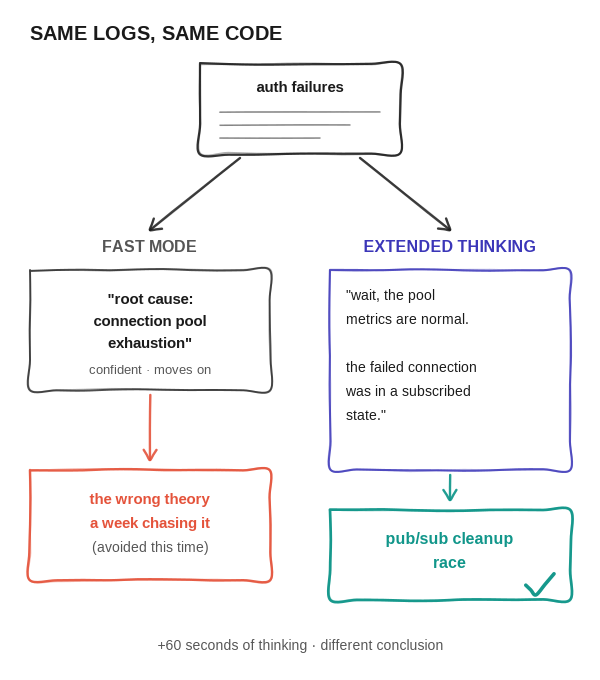
That extra 60 seconds of thinking saved a week of chasing the wrong theory.
If the fast answer had gone out, the likely path is the loop from earlier. Someone tunes the pool. The deploy goes out. The pool metrics, which were already normal, stay normal. The auth failures come back. And then we start again, now with a fix in production that didn't fix anything and needs explaining.
My rule now
So here's where I've landed, and I don't make exceptions to it any more.
If the answer drives a decision, a deploy, or a customer-facing change, use the strongest model at the highest effort. Always. No exceptions.
That doesn't mean everything needs the biggest model. Save the fast, cheap model for the debrief. For formatting. For the parts where accuracy was already established and you just need a summary. I wrote about that split in more detail in Cut to the Chase: let the strong model do the hard thinking, then hand its notes to a fast one to tell me what it found in a few lines. Speed is genuinely valuable there, because the expensive question has already been answered properly.
But for the work that matters? Let the model think.
The tokens are cheap. Your time is not. The wrong answer is the most expensive thing in your workflow.
Stop optimising for the cheapest line item.
What's the most expensive wrong answer you've seen from a "fast" approach?