This one is off topic. No Django, no Kubernetes, no AI agents. Just something that has been bugging me for years, every time I walk into a small bar or cafe overseas and there's a guy in the corner with a guitar, singing his heart out to forty people and a coffee machine.
Why don't we have that in India?
I don't mean concerts. India has huge concerts, film music nights, temple festivals and wedding bands. I mean the small, everyday version: a Friday night in a neighbourhood cafe, two or three musicians, a mic stand and a tip jar. Travel a bit and you'll see it everywhere. In Chennai or Bangalore it exists, but it's much rarer, and when it does happen it's usually not Tamil film songs.
My theory: it's not about talent or taste. It's about arithmetic. Faithfully reproducing even an average Tamil film song takes a big band, and a big band costs money that a small venue doesn't have.
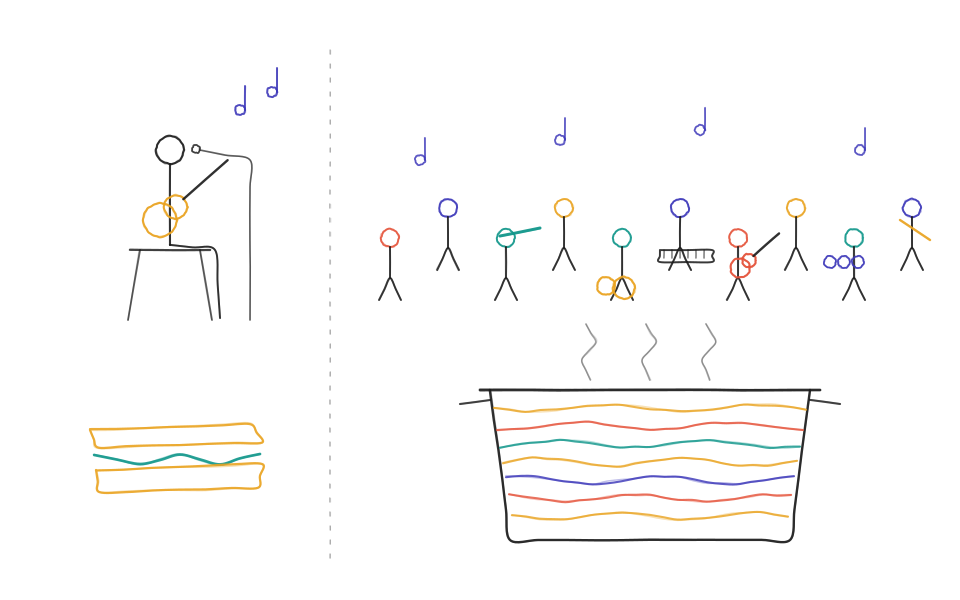
Indian film songs are complex at the foundation
Let me say the part that surprises a lot of Western friends. On a foundation level, Indian film songs are very complex.
Don't get me wrong. Complex Western songs exist. Queen exists. Prog rock exists. Jazz will happily melt your brain. But the default Western pop or rock song is built to be carried by a few people. The default Tamil film song is built in a studio, by a composer with an orchestra at his disposal, for a scene in a movie, and nobody involved was thinking about whether three people in a cafe could play it later.
Take an ordinary example. Not a Rahman masterpiece, not an Ilaiyaraaja symphony. Just a regular, well-loved album: Yuvan Shankar Raja's soundtrack for Yaaradi Nee Mohini (2008), the Dhanush and Nayanthara film. Put on "Oru Naalaikkul" and actually listen to everything happening underneath the vocals. Then imagine reproducing it faithfully, live, in a room the size of a living room.
My first instinct is to say you'd need a 200-member band. Okay, 200 is a stretch. But you will not get anywhere near the record with two people. Let's count properly.
You need two singers before you play a single note
Most Indian film songs are duets. Whether you agree with that or not, it's the reality of the catalogue. There's a male portion, there's a female portion, and they trade lines, verses and sometimes whole stanzas. "Oru Naalaikkul" is Karthik and Rita. "Nenjai Kasakki" on the same album is Udit Narayan and Suchitra.
And here's the funny part: you can't just have one singer cover both. A man can't really sing the female portion, and the other way round sounds odd too. The keys sit in different ranges, and because most of these duets are romantic, it gets awkward fast when one person is singing both sides of a love conversation. It's like a one-man play of a wedding proposal.
Long story short: one male vocalist, one female vocalist. Period. That's two people on the payroll and we haven't touched an instrument.
Then the instruments
Here's the smallest band I can imagine that would get through a typical Tamil film song without the audience wincing:
- Flute. So much of the melodic colour lives in the flute lines between verses. Without it the interludes are empty.
- Tabla. The rhythmic feel of a lot of songs comes from tabla or a similar hand percussion, not a drum kit.
- Keyboard or piano. The workhorse. A good keyboardist covers strings, pads, bells and half the orchestra with patches.
- Guitar. Rhythm parts, and often a lead line or solo.
- Drum pads. Most bands don't bring a full acoustic kit anymore, and that's fine. Electronic pads are highly versatile and can trigger almost any sound.
That's seven people including the two singers. Now the "you really should have" list:
- Congas or triple drums, because so many songs have a percussion section that tabla and pads don't quite nail.
- Bass guitar, because the low end matters more than people think.
- A dedicated lead guitar, separate from rhythm.
- Violin, for the string lines a keyboard patch only imitates.
And the "nice to have, but forget about it" list: nadaswaram for the songs that need it, and veena if you're feeling ambitious. You don't need them for every song, but when a song does, nothing else sounds the same.
Some people try to play tabla on the pads too. You can, and good players get close, but it isn't real tabla. The bols, the bends from the left-hand drum, the way the sound breathes: a sample doesn't do all of that.
Add it up and you land somewhere around ten people for a respectable version. Some parts can be folded into the keyboard, and that's fine, but I genuinely can't picture a Tamil live band that does justice to film songs with fewer than about ten members. For the full experience, think closer to twenty.
Two separate lanes: singers and players
Meanwhile, in plenty of places I've travelled, I've seen two-piece and three-piece acts holding a room. And very often the person singing is also the person playing guitar.
That's something you rarely see with Indian musicians, and I think there's a real reason for it. Indian vocals, Tamil film vocals included, are demanding. A huge number of our singers trained classically for years and dedicated their whole lives to the voice alone. Think about how many top Indian playback singers you've seen holding a guitar on stage. Not many. Playing an instrument at a high level is its own lifelong discipline, and singing at that level is another one. So it becomes two separate lanes.
In the West, the singer-songwriter with a guitar is practically an archetype. Ed Sheeran builds entire stadium sets out of one voice, a guitar and a loop pedal. Bruno Mars sings while playing. In a lot of Western bands the guitarist sings, the keyboard player sings, and sometimes even the drummer sings. One person covering two jobs halves the headcount, and that changes the economics of a small gig completely.
To be fair, it's not because Western singing is easy. A great pop vocal is hard. It's that the songs are usually designed so the voice and a couple of instruments can carry them.
Biryani versus a sandwich
The more you listen, the more you realise an Indian film song is like a biryani. There are layers and layers. Rice, masala, meat, fried onions, saffron, mint, a dozen spices doing their own thing, and somehow it all has to come together at once.
A typical English pop song is more like a sandwich. Toast two slices of bread, put something good inside, done. And I say that with love. A great sandwich is a great meal, and nobody complains that a sandwich isn't a biryani.
There's a running meme online where someone proudly shows a "perfect meal" and an Indian person replies, roughly, "Perfect meal? That's just the prep work. Where does the cooking start?" That's exactly the gap I'm talking about, applied to music.
Where the richness actually comes from
Now let me correct my own brainstorm, because my first take was unfair.
It's tempting to say Western music is "flat" and "just twelve semitones". That's not quite right. Indian music uses the same twelve-note octave as its working frame; the harmonium and keyboard that half our film industry runs on are tuned to it. The richness isn't in having more notes. It's in what you do between and around them:
- Raga grammar. A raga isn't just a scale. It has rules for how you approach and leave notes, which phrases belong to it and which notes to emphasise.
- Gamakas. The ornaments, slides and oscillations that make a note move. A note in Carnatic music is often more of a gesture than a fixed point.
- Shrutis. The finer pitch shades that theory recognises within the octave, which singers use for intonation and expression.
- Tala. Rhythmic cycles that percussionists play with, around and against.
- Layered orchestration. Film composers stack all of the above with strings, synths, folk percussion and choir.
Western music has its own depth, especially in harmony. Chord progressions, voice leading and counterpoint are where a lot of its richness sits. Popular Western songs just tend to be lighter on layers by design, and that is precisely why they travel so well into small rooms. A strummed chord progression can carry a song. A raga-based melody with orchestral interludes can't be carried by strumming alone.
Different recipes, not better and worse cooks.
So it comes down to money
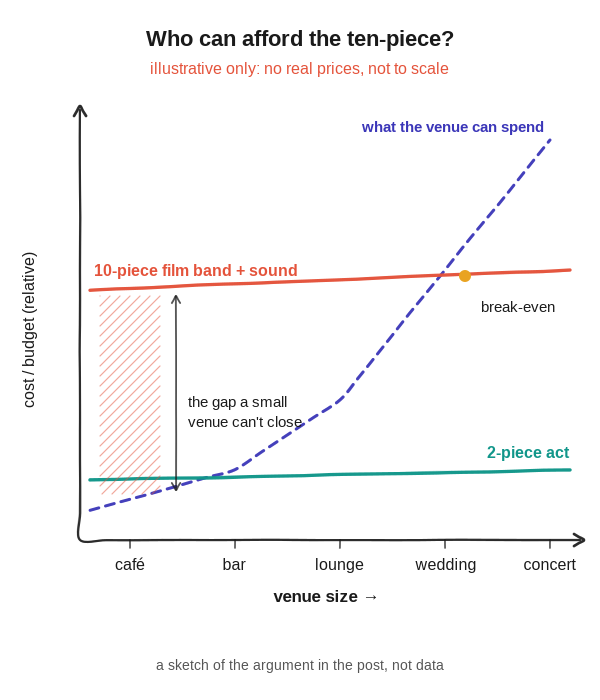
Here's where it lands. If a cafe wants a two-piece, that's two people to pay, two people to feed and a corner of the room. If it wants a Tamil film band that won't get booed, it needs:
- A bigger group, so a much bigger total fee.
- A bigger space, with room for ten musicians, their gear and a proper sound system.
- A bigger crowd, to justify all of that on a Friday night.
And the audience is unforgiving. Everyone in the room knows the original recording note for note. Try a thin cover of a beloved song with one guitar and the missing flute line and percussion break are obvious. It sounds flat, and you'll be booed off stage. So the small venues mostly don't bother. They play recorded music or hire a DJ, and live film music moves to bigger venues, weddings, college culturals and ticketed shows, where the budget exists.
The honest counterpoints
I don't want to overstate this, because small live music in India does exist.
- Unplugged and acoustic covers of Tamil and Hindi songs are popular, especially online and in some cafes.
- Ghazal nights have always been intimate: a singer, a harmonium, a tabla, often in small rooms.
- Carnatic concerts in Chennai's sabhas, especially during the December music season, are often small ensembles: a vocalist with violin and mridangam.
- Indie bands in Bangalore, Mumbai, Delhi, Chennai and the Northeast play small venues all the time, usually their own songs, often in English.
- Karaoke and backing-track nights are a whole culture of their own.
- Folk traditions across India have performed with small groups for centuries.
And simplicity isn't inferior. Some of my favourite live moments anywhere have been one person and one instrument.
There are also ways a small act can make Tamil film songs work:
- Reduced arrangements that keep the hook and drop the orchestra.
- Acoustic reinterpretations, where the point is a new take, not a copy.
- Backing tracks for the parts you can't staff, with live vocals and one or two live instruments on top.
- Loop pedals, the Ed Sheeran trick, to layer parts live.
- A really strong keyboardist, who is honestly worth three people.
The catch is that each of these changes the promise. You're no longer selling "the song you love, played live". You're selling "a new version of the song you love". Some audiences love that. Many still want the biryani.
My take
Small venues in India rarely have live singers because our songs are built for a full kitchen, our singers and instrumentalists usually work in separate lanes, and a ten-piece band is expensive. That's not a weakness. It's the price of a musical tradition that layers everything.
I'd still love to see more small acts try the reinterpretation route, with a keyboardist, a tabla player and two good singers. A smaller biryani, not a sandwich.
If you've been to a small venue in India that pulls this off, tell me where. And if you're a musician who has tried, how small did you manage to make the band?