There's a version of a software career where you chase every new framework, rewrite your stack every eighteen months and spend more time on migrations than on the product. Plenty of us have done a stretch of it. The systems that last, the ones that ship features for years without drama, are almost always built on the dullest tools available.
The position: boring technology is a competitive advantage, not a compromise. Python, Django, Postgres, a load balancer and a few well-understood AWS services will take most products further than any shiny stack. The skill isn't knowing the newest tool. It's knowing when not to use it.
Boring means understood, not old
Dan McKinley's essay Choose Boring Technology put it better than anyone: a boring tool is one whose failure modes are known. You can search the error message and find the answer. You know how it behaves under load, how it breaks, and how to fix it at 2 am.
That's the real asset. Not features. Not benchmarks. Predictability.
Django is boring in exactly this way. The ORM has its sharp edges, and they're documented. The migration system has its quirks, and Stack Overflow has an answer for each one. Postgres is boring. Gunicorn is boring. SQS is boring. Every one of them has had its corner cases found by many people before you.
A new tool has failure modes too. You just don't know them yet, and you'll discover them in production.
Spend your innovation where customers notice
McKinley's other idea is the innovation token: every team gets a small number, and each new, unproven technology spends one. Spend them on what makes your product different. Not on the plumbing.
If your product is a pricing engine, innovate on pricing. Run it on Django and Postgres. If your product is a new kind of search, maybe the search engine is your token, and everything else should be as dull as possible.
The common failure is the reverse: a completely ordinary CRUD product running on a novel database, a new frontend framework, an event-sourcing library and a service mesh. Four tokens spent, none of them on anything a customer will ever see.
The habits that held up
Some lessons I'd give my younger self, in no particular order:
- Read the standard library before installing a package.
dataclasses,pathlib,itertools,functools,zoneinfo,concurrent.futures,sqlite3. Python ships a lot. Every dependency is code you didn't write and will have to upgrade. - Prefer a function to a class, and a module to a framework. Most abstractions people build in Python are a function with extra steps.
- Plain SQL is a skill, not a smell. The ORM is great for 90% of queries. For the other 10%, reading
EXPLAIN ANALYZEbeats any amount of queryset cleverness. - Delete code aggressively. Dead feature flags, unused endpoints, compatibility shims for clients that no longer exist. Every line you keep is a line someone has to understand.
- Logs and metrics before features. You can't fix what you can't see. A structured log line with a request ID has saved more incidents than any architecture change.
- Upgrade little and often. Staying one minor version behind on Python and Django is cheap. Falling three major versions behind is a project with its own budget. I say that as someone who defended Python 2.7 long after the argument was lost.
- Write the boring test. Not a clever property-based suite for everything. One test per business rule, named after the rule, that fails clearly.
Invest in tests that don't know how the code is written
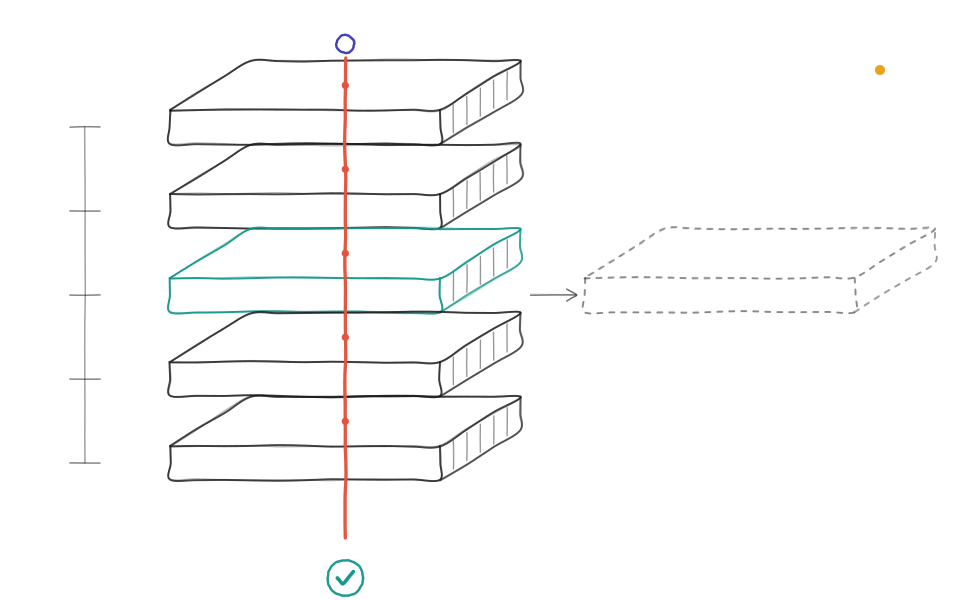
If I could move one budget line on most teams, it would be this: spend far more on black-box tests that walk through real user journeys. Sign up. Log in. Place an order. Cancel it. Get the refund email. Drive them through the public surface, the HTTP API or the UI, and check what a user would check. Nothing else.
These tests don't import your models. They don't patch your functions. They don't know whether there's a service layer, a serializer or a stored procedure behind the endpoint. That's the point.
Everything in your stack is temporary. The framework gets a major version. The database moves. The queue gets swapped for something managed. The cloud service you picked gets deprecated. Python itself moves on, whether you're ready or not. And one day somebody will want to rewrite the whole backend.
When that day comes, everyone asks the same question: did we break the product? Unit tests tied to internals can't answer it. They die with the refactor, because they were testing the code you just deleted. A journey suite survives it. It runs against the new system exactly as it ran against the old one, and when it goes green you can say, with evidence, that the product still works.
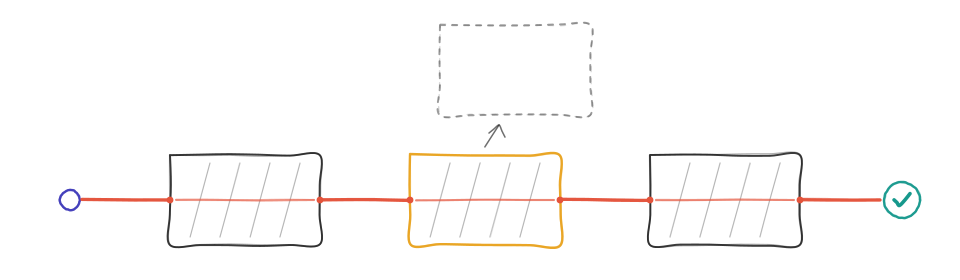
That's why I call it an asset. It grows. Every journey you add is one more thing you can never silently break again, through any number of rewrites. Most code loses value as it ages. This suite gains it.
How I'd keep it boring:
- Few and honest. Tens of journeys, not thousands. Cover what earns money, and what would have customers emailing you before your coffee.
- Real dependencies. Run them in CI against a real Postgres, a real queue and real services in containers. Fake only what you don't own, like the payment provider, and fake it at the network edge.
- Behaviour, not implementation. Assert on status codes, response bodies, emails sent, what the user can see. Never on which function got called.
- Slow is fine. A few minutes per run is the price of honesty. Run them on every merge, not on every keystroke.
- Cheap to keep. They don't know how the code is written, so refactors don't touch them. If a refactor breaks one, either behaviour changed or the test was peeking inside.
This is boring technology applied to testing. The journey suite is the one part of the system that doesn't care what's fashionable underneath. Rip out Django REST Framework for plain Django views (I'd encourage it) and the suite won't notice. That's exactly the predictability you want while everything else moves.
Unit tests still earn their place for tricky pure logic: date maths, pricing rules, parsers. Keep those. Just don't mistake a pile of mocks for proof that the product works.
Complexity is a loan
Every piece of complexity you add is borrowed against future time. Microservices, a second database, a message bus, a custom deploy tool. Each one might be justified. Each one charges interest: on-call load, onboarding time, upgrade work, things that can partially fail.
The question I ask now before adding anything is simple: what's the cheapest thing that could possibly work, and what evidence would make me outgrow it? Write the evidence down. "When the jobs table bloats past what autovacuum can handle." "When two teams are blocked on the same deploy." Then build the cheap thing and watch for the evidence.
Most of the time, it never shows up.
Where boring goes wrong
Boring isn't the same as stagnant. A few traps:
- Boring isn't unmaintained. Running an end-of-life Python version isn't conservative, it's a security liability. Boring tools still need upgrades.
- Boring isn't "what we used last time" forever. If a new tool is mature, well understood and clearly better for a real problem, like
uvfor Python packaging orrufffor linting, adopt it. The test is maturity and fit, not age. - Boring isn't refusing to learn. Learn the new things. Build side projects with them. Just don't make your production system the place where you learn them.
What actually made the difference
Looking back, the projects that went well had little to do with the stack. They had:
- A clear understanding of what the business actually needed this quarter.
- A small number of well-understood moving parts.
- Fast, boring deploys, many times a week.
- Engineers who could explain the whole system on a whiteboard.
The projects that struggled usually had an impressive architecture diagram and nobody who could explain all of it.
Bottom line
Years of Python have taught me that the most valuable engineering skill is restraint. Use the tool everyone understands. Spend novelty only where it creates value customers can feel. Keep the system small enough to fit in one head, and keep a suite of journey tests that will outlive it. It doesn't make for exciting conference talks, but it makes for software that ships, keeps shipping and lets you sleep.